July 8, 2026

en

What Is the Human Agency Scale (HAS) and Where Does Temelion Actually Stand? We Asked Our Team for their Insights.
The Human Agency Scale (HAS) is a five-level framework developed by Stanford's SALT Lab that measures how much human involvement a task requires when AI enters the workflow. Unlike most AI benchmarks, it's not a ranking of AI capability, it's a map of human involvement, ranging from H1 (full AI autonomy) to H5 (continuous human presence essential). For AI SaaS companies, knowing where your product sits on this scale is one of the most honest things you can do.
We asked our own team at Temelion. The answers were direct, slightly contradictory, and more useful than any polished self-assessment.
What Is the Human Agency Scale?
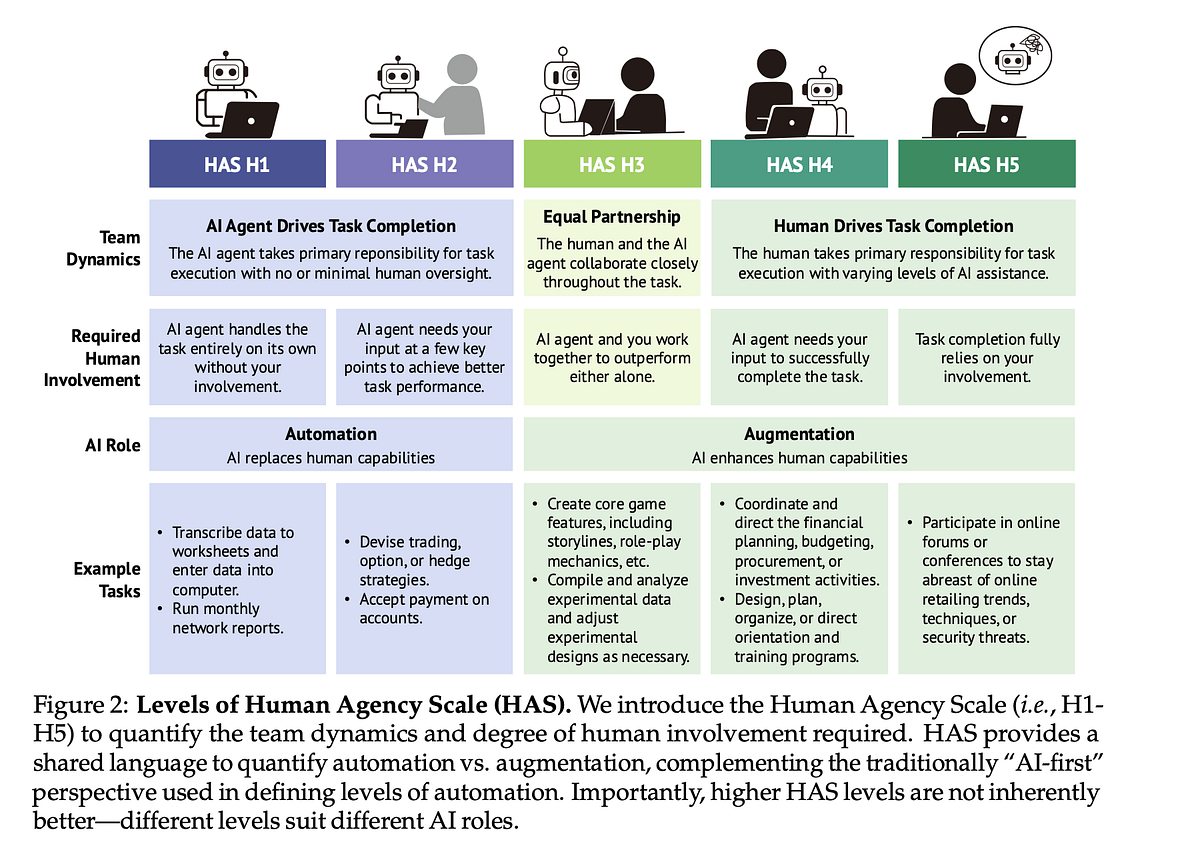
Stanford's SALT Lab introduced the Human Agency Scale to give product teams, researchers, and workers a shared language for describing the right level of human involvement in AI-assisted workflows. It runs across five levels:
H1: Full AI autonomy. The AI handles the task entirely without human input during execution.
H2: AI leads, humans provide minimal oversight. The AI does the heavy lifting; a person validates or catches edge cases, but isn't co-producing the work.
H3: Equal partnership. Humans and AI contribute as genuine collaborators. Neither dominates. The combined output exceeds what either could produce alone. Research across 844 tasks and 104 occupations found H3 to be the dominant level workers actually want, preferred in 45% of occupations surveyed.
H4: Human leads, AI assists. The human is firmly in control. AI handles sub-tasks, like drafting, extracting, flagging but direction and judgment come from the person.
H5: Human essential, AI minimal. The task fundamentally requires human presence, relationships, or contextual judgment throughout.
A critical insight from the research: higher numbers are not better. H1 and H2 suit automation; H3 through H5 call for augmentation, tools that make humans more capable, not tools that replace their involvement.
Why the Human Agency Scale Matters for AI SaaS Products
For AI product teams, HAS solves a real problem: the gap between how products are marketed and how they actually function.
A lot of software positioned as "agentic" is operating at H3. Multi-step pipelines with human review at the end are H3 or H4 systems, regardless of the label. That mismatch creates expectations that products can't meet, and users figure it out fast.
HAS also flags a common design error. When tools are built assuming H2, minimal human touch, but the people using them need H3 control surfaces, friction shows up in adoption rates, errors, and the persistent feeling that the AI "doesn't quite fit." That's usually a design problem, not a people problem.
The Stanford research adds one more practical signal: workers consistently want more human agency than technical experts assume is necessary. Even tasks that are technically automatable may perform better under a co-pilot design, because the people doing the work want to stay in the loop.
Where Does Temelion Sit on the Human Agency Scale?
We asked the question directly to our team, tech, product, and leadership. No prepared answers. Here's what came back.
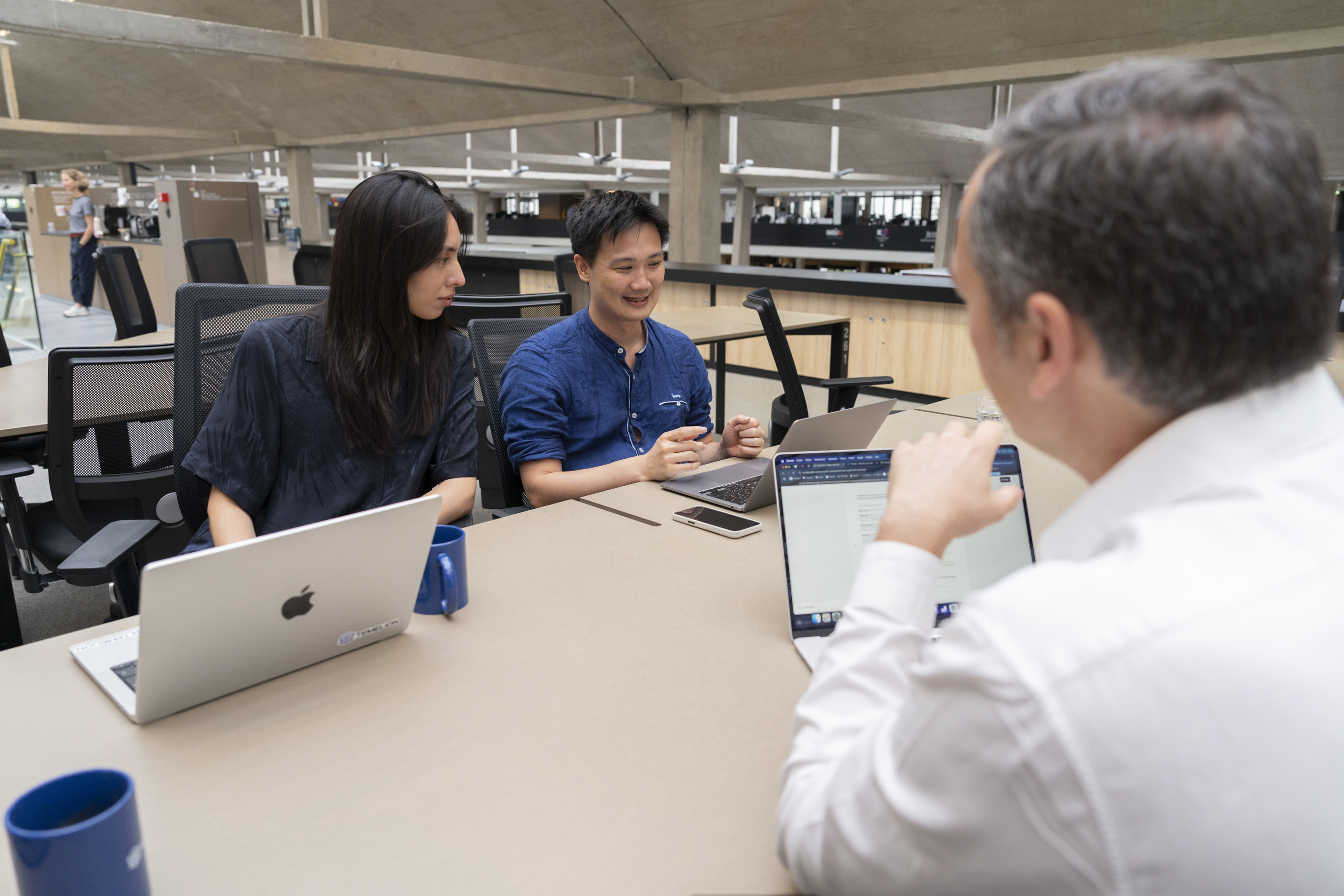
From the tech side, from the perspective of the development of the platform:
"For the tech team, definitely H4 or H5. It really depends on the person. AI is used to help with code, but we don't use it to create features or organise our work. Some use AI coding tools to a degree, but we want our code to stay clean, so someone always reviews. For the product, I know they use it for brainstorming, wireframes, UI mockups so the team can visualise things quickly. Mostly H4 or H5, but maybe H3 for the UI work. Overall: AI is a great tool, but we're still heavily human-driven."
From a product perspective:
"Definitely H3.True H2 means agentic systems where AI collaborates with other agents with minimal human interruption. That's not what we are trying to do here, the control always lies with the human."
From our product lead, how the user sees it:
"I'd say H4, though I can see how someone could argue H3. The core mindset is: AI does the heavy lifting on repetitive, boring tasks and produces a first version. Then the user completes it with their own input. The user always approves the final version."
What "Between H2 and H3" Actually Means in Practice
For those who placed Temelion between H2 and H3, the practical implication is this: the AI is doing enough of the work that it materially changes what the user needs to do. But the workflow doesn't close without human judgment. You're not just reviewing, you're co-authoring.
In the context of Temelion's products, that looks like this:
When an engineer uses Generation MT, the AI reads the RFP (“appel d'offres”), extracts project requirements, cross-references the firm's past work, and drafts a structured Technical Proposal (“mémoire technique”) section by section. The engineer reviews it, applies lived-in knowledge, and signs off. When ACT normalises contractors offers (“DPGF”) data across multiple submissions and generates a comparative scoring grid, a bid manager reads that grid and makes the attribution recommendation.
The AI compresses the time and reduces the risk of error. The human owns the decision. That's H3 to H4, not H1 or H2, and not H5.
The Honest Assessment: H3 to H4
Across the team, the consistent answer is H3 to H4, with H4 as the design intention and H3 as what the experience often feels like in practice.
The principle Jerome articulated is close to a product doctrine: AI handles the first version, the user approves the final one. For engineering workflows where a technical proposal (“mémoire technique”) represents months of revenue and a DPGF comparison informs a financial commitment, that level of human involvement isn't a limitation, it's by design.
FAQ: Human Agency Scale and AI in Construction Engineering
- What is the Human Agency Scale (HAS)? The HAS is a five-level framework from Stanford's SALT Lab that describes how much human involvement a task should retain when AI agents enter the workflow. It ranges from H1 (AI solo) to H5 (human essential throughout), and is designed as a descriptive tool, not a ranking of which level is best.
- Is H1 or H2 better than H3 or H4? No. The framework explicitly states that higher levels are not inherently superior. H1 and H2 are appropriate for automation use cases; H3 through H5 are appropriate for augmentation, where human judgment, context, or accountability must stay in the loop.
- What level do most workers prefer when working with AI? According to the Stanford research across 844 tasks and 104 occupations, H3 (equal partnership) is the most preferred level, desired in 45% of occupations. Workers consistently want more human agency than technical experts assume is necessary.
- What is the difference between H2 and H3 for AI SaaS products? At H2, the AI drives the workflow and a human provides minimal oversight, largely validating a near-complete output. At H3, the human and AI are active co-producers: each contributes something the other cannot, and the collaboration is iterative. Many products marketed as "agentic" are actually operating at H3.
- Why does knowing your HAS level matter for an AI product team? Because mismatched HAS design creates adoption failure. If a product is built for H2 but the workflow requires H3 control surfaces, the ability to intervene, edit, and redirect at multiple points, users experience friction that looks like a people problem but is actually a product design problem. HAS gives teams a precise language to close that gap.
This post draws on the Human Agency Scale framework from Stanford's SALT Lab. Read the original paper: Future of Work with AI Agents. Summary via Today in AI on Medium.
Temelion builds domain-specific AI tools for French construction engineering firms.
Generation MT automates mémoire technique production. ACT handles bid review, DPGF extraction, and offer comparison.