March 26, 2026

fr

As AI gains ground across AEC, one uncomfortable truth keeps surfacing: the tools are not enough.
Alright, let's rewind, data does show that AI adoption correlates with faster delivery and higher‑quality outcomes. However, those gains almost always appear when AI is paired with better decision‑making, not when it is treated as a quick fix or a plug and play avenue.
Research published in Automation in Construction puts it plainly: significant decisions in AEC are rooted in heuristic reasoning built from years of professional experience. AI can surface patterns and correlations in data at a scale no human can match, but it cannot replicate the contextual intelligence that drives the most consequential calls on a project. Another way to say that AI in AEC will not replace experts, it will propel them to deliver better results.
The firms that are actually pulling away from the pack are investing in both: robust AI capabilities and the decision infrastructure to use them well. Both are hard, for sure. In practice, that means leaders who can frame the right questions, teams that understand the limits of model confidence, and workflows where AI outputs are inputs to professional judgment, not replacements for it. That is a lot for teams to explore, however, if there is place to start, this is it.
The question is no longer “Can we use AI?” but “How do our people make better decisions because of it?”.
Let's explore some of these ideas together.
The decisions that actually shape projects
We loved the interview of Amy Bunszel, EVP of AEC Solutions at Autodesk, in AEC Mag, where she says that early decisions have always carried outsized weight in AEC. Even more so in 2026, the tolerance for revisiting these decisions later is shrinking fast. What were once treated as provisional choices are now expected to hold as projects move forward, with far less room to course‑correct downstream.
Some of the high stakes decisions outlined in her interview where AI can surface consequences sooner but where human judgment must still drive the call:
- Site strategy & massing
Sets the physical and financial logic of the entire project.
- Feasibility & risk assessment
Owners need credible answers before committing serious resources.
- Performance trade‑offs
Energy use, carbon impact, resilience, which are now the baseline expectations, not afterthoughts.
- Sequencing & construct-ability
Scheduling assumptions locked early determine cost and delivery certainty.
- Spatial & systems alignment
Carrying design intent from concept through detailed layout without losing the thread.
- Lifecycle cost & sustainability
Long‑term operational viability, not just delivery cost.
- Capacity & resource allocation
With fewer people and tighter margins, every resourcing call has a multiplier effect.
Bunszel’s core argument is one every AEC leader should internalise: AI’s real value is not speed, but it isconfidence, the assurance that early design decisions, grounded in shared data and tested assumptions, will translate into solutions that are actually viable to build and operate.
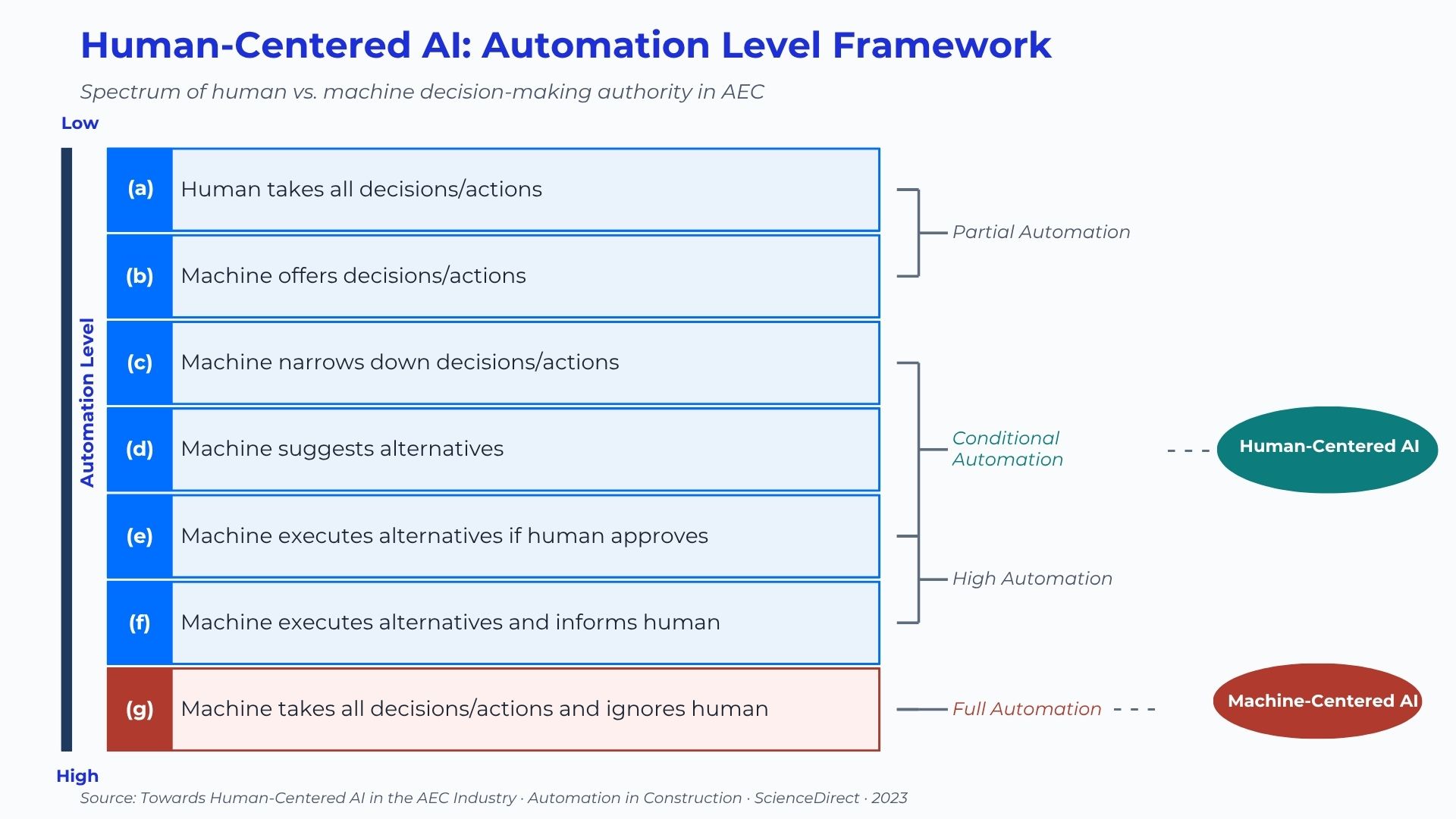
To look at these decisions on a spectrum of Machine and Human centered process and their range, it helps to look at how decision‑making authority can shift along the AI spectrum. In a recent “human‑centered AI” framework for AEC, automation ranges from humans taking every decision to machines acting entirely on their own and ignoring human input.
The most interesting territory for construction firms sits in the middle: AI narrows options, suggests alternatives, or executes actions only when a human approves, while experienced practitioners stay firmly in charge of the calls that matter. This is exactly where pairing machine insight with human heuristics becomes a multiplier, not a risk. To put it simply, AI does the heavy lifting on analysis, and humans decide what the project should actually do.
What “better human decisions” actually entails
So what does it entails to get to “better human decisions”? For starters, being equipped to operate in an AI‑augmented environment would enable a user to look at the problem from both ways:
- Asking sharper questions of AI‑generated outputs.
- Understanding where model confidence ends and your professional judgment kicks in.
- Building cultures where insight flows quickly to the people empowered to act on it.
- Knowing where your organisation needs help and which pilot to test first.
Bluebeam’s research underscores this: the firms extracting real value from AI “knew what their core problems were and how AI could solve them.” That clarity, that problem‑first thinking, is a leadership and decision‑making capability, not a technical one. In other words, the differentiator is not who has access to AI, but who knows what they’re using it for.
In that context, Temelion sits in a very specific space: helping AEC teams see the consequences of their design and delivery choices earlier, when judgment still has room to move. By turning fragmented project data, and heavy data points into decision‑ready insights instead of another stream of noise, it’s designed to support the kind of human‑in‑the‑loop, heuristic‑driven practice this piece argues for, where AI does the heavy lifting on analysis, and practitioners stay focused on making the calls that actually shape projects.
Before we close the argument, we would be remiss to not mention change management and decision infrastructure in this process. Check out this space for more next week on change management and decision infrastructure.
If you'd like to speak to someone on our team to explore more about what we do and how we can help you, book a spot with our team here.