December 15, 2025

en

The year 2026 is forecasted to be a pivot year where stricter low‑carbon regulation, a cautious but real market recovery, and rapidly maturing AI‑driven workflows combine to change how buildings are designed, coordinated, and delivered from end to end.
For building design engineers and architects in France and across Europe, the shift is from simply “doing BIM” to orchestrating carbon, cost, construct-ability, and compliance using integrated digital tools and data‑centric processes.
In part 1 of the analysis we deep dive into global shifts within the Engineering and Construction industry expected in 2026. In part 2, we deep dive into France and Europe.
Part I | The Global Architecture, Engineering and Construction Scenario in 2026
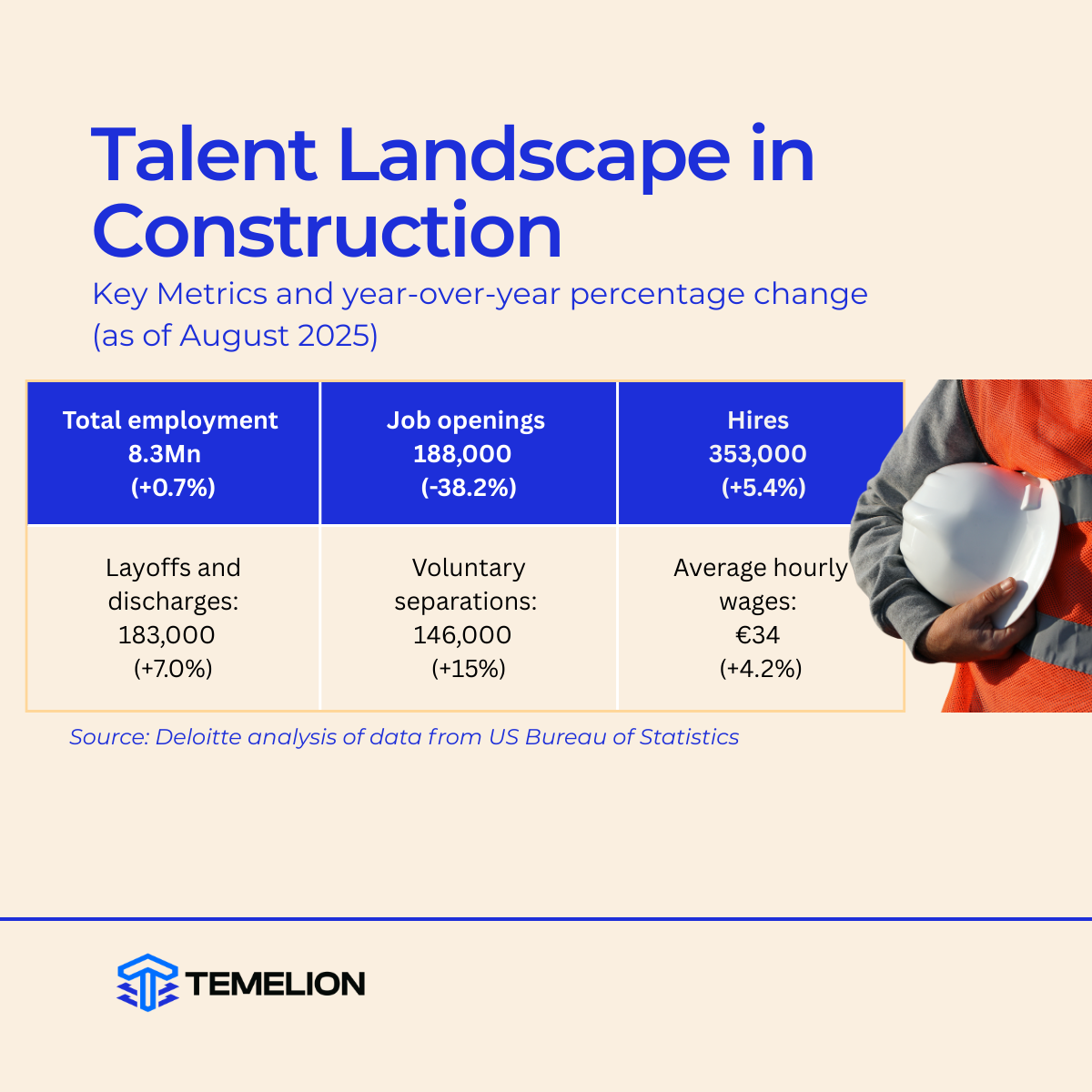
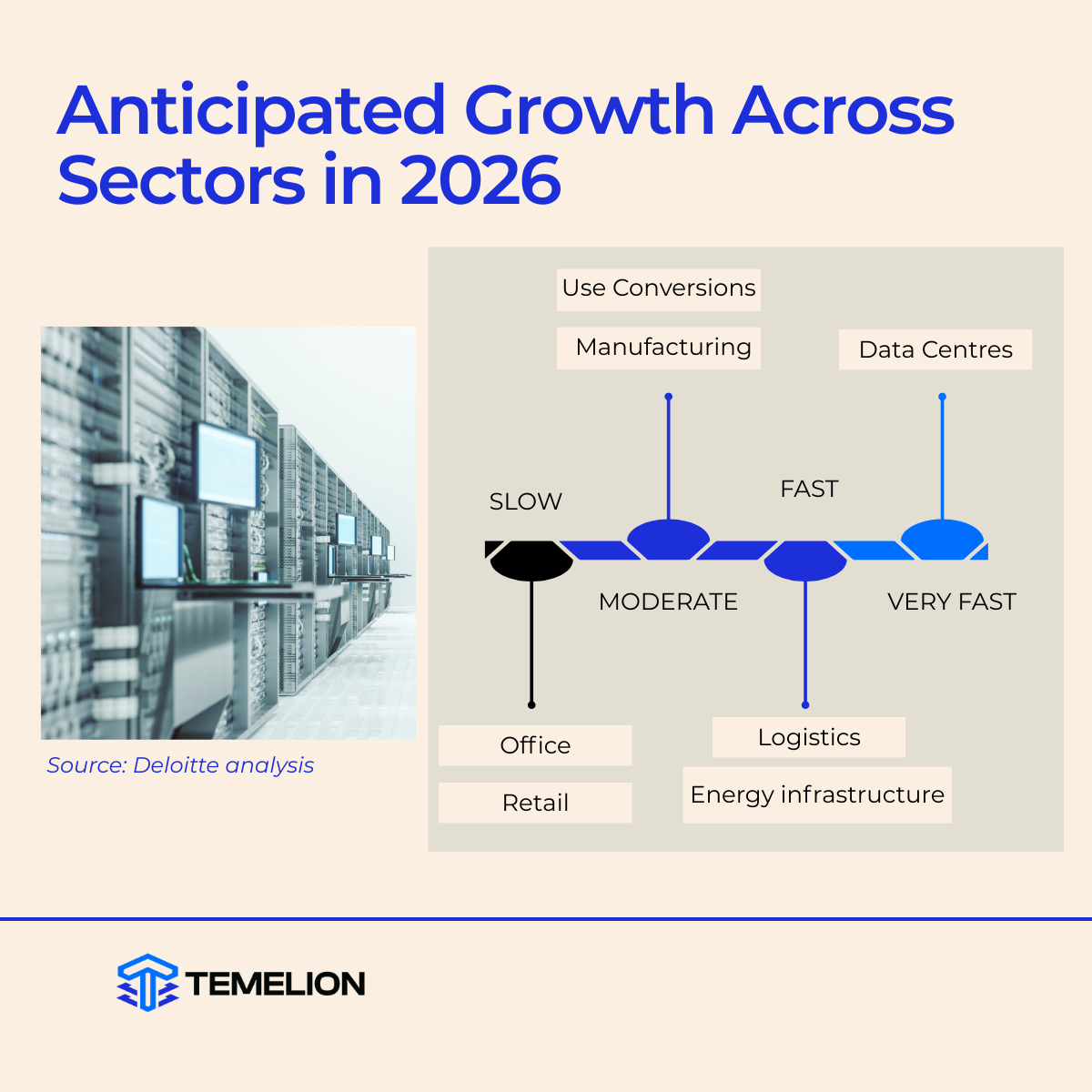
Traditional commercial and parts of residential construction will continue to be under pressure leading to a slugging growth in 2026. At the same time, however, infrastructure, industrial facilities, logistics platforms, and data centres become the main sources of new work.
Due to this shift, design teams will face fewer routine, “standard” projects and a higher share of complex, highly serviced buildings that require more engineering coordination and performance‑driven design.
#1 Low‑carbon as default
- High energy‑efficiency standards and decarbonisation targets in many markets are making low‑carbon design a baseline expectation rather than an optional upgrade to the project brief.
- Life‑cycle assessments (LCAs), environmental product declarations (EPDs), and quantified carbon budgets are increasingly being brought into the earliest stages of design, influencing choices of structure, envelope, and MEP systems from the start.
#2 Built for Scale and an industrialised delivery
- Despite initial sluggishness in this sector, modular, prefabricated, and even 3D‑printed building systems are making a respectable comeback in sectors like multifamily housing, healthcare, education, and industrial projects, pushing teams toward more repeatable and factory‑friendly design. This comes in response to the rising costs of construction material and labour shortages.
- This industrialised approach requires design engineers to commit to earlier design freeze, produce DfMA‑ready geometry, and create details that explicitly account for manufacturing constraints, logistics, and on‑site assembly sequences.
Reference: The Birmingham Group
#3 Contech, AI, and Automation: From Pilots to Platforms
3.1 Agentic AI in AEC workflows
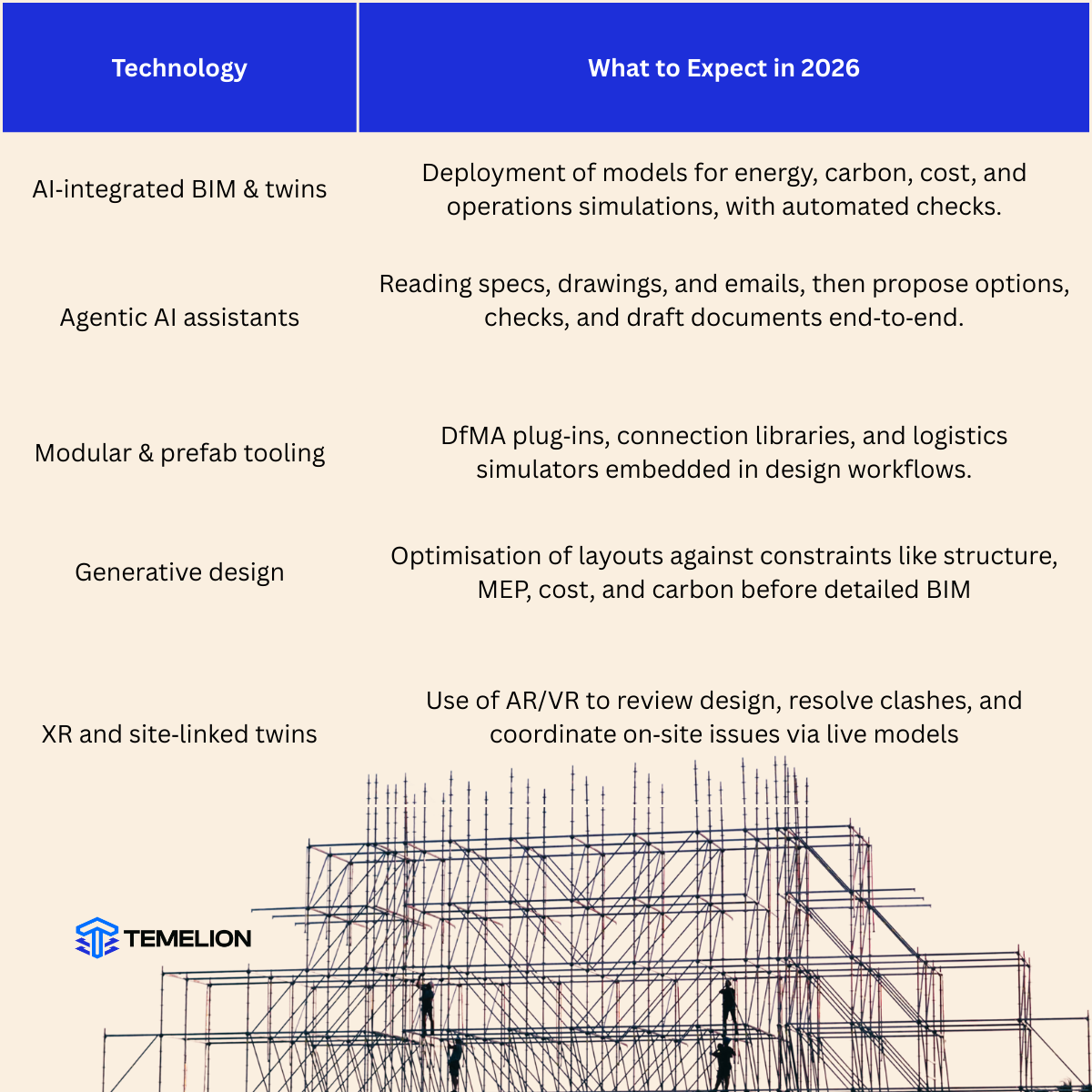
2026 is the year AI in construction stops being a set of isolated experiments and starts to look like a real operating layer across design, planning, and site execution.
- AI systems are evolving from generic assistants that simply answer questions into agentic tools that can read drawings, models, specifications, and emails, reason about requirements and constraints, and then trigger concrete actions across multiple applications.
- In practice, these AI agents will increasingly generate code‑compliance checks, draft technical documents, suggest design alternatives, and open or update issues directly in project management and BIM environments.
- Temelion leverages AI to automate and simplify complex technical documentation and deliverables for building design engineers, ensuring precision, compliance, and faster project delivery. Connect with our teams here.
- Reference: xpedeo
3.2 BIM + digital twins + AI = A leap for AEC
- BIM and digital twins are shifting from static geometry containers to dynamic layers used for simulation and prediction of energy performance, comfort, carbon impact, and operational behaviour over the asset’s life.
- To unlock these capabilities, model quality must improve significantly, with consistent structures, parameters, and metadata so that AI and analytics tools can trust and process the information without constant manual cleaning.
3.3 Robotics, drones, and reality capture
- For medium and large-scale projects, drones, 360° cameras, and construction robots are becoming regular tools providing frequent site scans that show progress, detecting deviations, and flagging safety or quality issues early.
- The data captured on site is increasingly being pushed back into BIM and planning tools, creating a feedback loop where field conditions inform design adjustments, clash resolution, and claims or variation management. The ways and means of working with technology means tighter human-in-the-loop workflows.
3.4 Interoperable, cloud‑based platforms
- The industry is gradually moving from isolated point tools to cloud‑based ecosystems that connect design models, cost data, schedules, carbon metrics, and ESG indicators into unified views for project teams and clients.
To work well within these ecosystems, design deliverables must be structured, machine‑readable, and API‑friendly so that automated compliance checks, dashboards, and analytics can run without constantly relying on manual exports and reformatting.
Part II | France and Europe: Market and Policy Lens
Across Europe, the sector has experienced or is experiencing a shallow downturn through 2024–2025, but is expected to return to modest growth around 2026, however there are significant differences between countries.
Some markets such as Poland, Ireland, and parts of Eastern Europe are projected to grow more quickly, while Germany, Italy, France, and certain Nordic countries may recover more slowly, even though all are pushed by similar drivers such as Green Deal funding and industrial decarbonisation.
Let’s start with France.
The French construction market has been hit hard in 2024–2025 by falling housing permits, higher financing costs, public budget pressures, and inflation, leading to reduced activity in both residential and segments of non‑residential building. We’ve covered it before on our blog here.
From 2026 onward, forecasts point to a moderate rebound driven less by classic new housing and more by energy‑transition projects, transport and urban infrastructure, industrial installations, logistics hubs, and data‑centre developments.
#1 Regulatory “twin transition”: green + digital
- European policy frames 2025–2026 as a pivotal period of “twin transition” in which both green and digital requirements intensify and start to reshape the business models of construction and engineering firms.
- This transition shows up in stricter energy and carbon codes, renovation‑wave incentives, requirements for circularity and resource efficiency, and public procurement rules that explicitly favour low‑carbon, industrialised, and digitally supported solutions.
RE2020 and European carbon regimes
- France’s RE2020 regulation is one of the clearest examples of how operational and embodied‑carbon limits can be integrated, using progressively stricter thresholds to steer projects toward efficient envelopes, heat pumps, low‑carbon concretes, and timber or hybrid structural systems.
- Other European countries are introducing or strengthening similar frameworks, so by 2026 many new builds and major refurbishments will require designers to produce quantified carbon assessments and documented compliance as a standard part of their work.
#2 AEC Tech in Europe: AI‑Ready, Carbon‑Aware Workflows
2.1 From experimentation to embedded AI
- The expectation for European AEC firms in 2026 is that AI should no longer be treated as a lab experiment or isolated feature, but as an embedded engine that quietly powers checks, predictions, and document generation within core workflows.
- Typical integrated use cases include early‑stage massing linked to performance metrics, automated scanning of models and documents for code conformance, and model‑driven generation of specifications, bills of quantities, and reports directly from a single source of truth.
2.2 BIM platforms evolve
- European‑focused BIM platforms are evolving to include AI assistants built into the authoring environment, automation for repetitive detailing and documentation, and early‑stage embodied carbon calculations connected to local databases and standards.
- This evolution sets a higher bar for deliverables: models are expected not only to be geometrically correct, but also “carbon‑ready,” “fabrication‑aware,” and structured so that AI and downstream tools can reliably interpret and use them.
Engineers and architects face persistent challenges as they contend with increasingly complex and occasionally conflicting carbon-related regulations, along with the substantial workload of producing LCAs and gathering dependable product data. Fragmented information environments, where models, drawings, spreadsheets and e-mails remain siloed, undermine automation, accuracy and coordination, resulting in more clashes and redesign cycles.
Meanwhile, design scope continues to expand without corresponding increases in fees, even as firms compete to attract and retain talent that combines engineering, BIM and data or AI skills, often against better-resourced technology and industrial sectors.
Temelion exists to fundamentally improve how engineering firms operate in the built environment. By harnessing the power of artificial intelligence, we streamline complex, repetitive workflows in pre-construction and technical delivery, enabling engineers to move faster, decide smarter, and focus on actual engineering. Connect with our teams here.