Rini Bankhwal
November 26, 2026

Rini Bankhwal
November 26, 2026

In July 2026, McKinsey published an analysis of how AI will affect architecture, engineering and construction. Here is what we take from it for French maîtrise d'œuvre.
Imagine a scenario: a late engineering change, or some prefabricated construction elements that no longer fit, a missed delivery. Usually, this is the start of several days of queries, drawing reviews, and rescheduling and cost verifications.
McKinsey describes another scenario, one that is becoming more and more possible. AI agents cross-check the model, the drawings, the orders and the schedule, identify the cause and elaborate on the cost options. Within hours, the engineer on the job has a consolidated view. Ultimately, the engineer takes the final call. The decision stays human; only the gathering and processing of information has changed hands.

The construction sector has really gone through it. Between 2000 and 2022, construction productivity grew by only 10%, against 90% in manufacturing, according to the McKinsey Global Institute.
Could it be that the next wave of growth in construction comes from AI? McKinsey estimates AI could automate roughly half of nonphysical work in architecture and engineering.
Not design, not signing off, not liability. The reading, checking, formatting and document coordination that surround every project - these are up for grabs.
Time savings won't stay an advantage for long.
Once every firm drafts faster, speed becomes the baseline. So how will firms bill their clients?
Lasting advantage will go to firms that control three things: their own project data, the workflows where decisions are made, and the ability to bill for outcomes rather than hours.
That third point matters most for engineering firms. A sector paid for time spent risks handing its productivity gains straight back to clients. The alternative is to sell reliability: fewer surprises, firmer schedules, better-managed risk, a smoother working experience. Fixed fees, milestone payments and shared savings all move in that direction.
The window is still open. A Bluebeam survey of 750 US industry decision-makers, published in November 2026, found that only 28% of AEC firms have moved AI into operational use, and just 7% have embedded it across core workflows. Yet 40% of firms running AI in production report savings above $500,000. In Europe, AI and automation could be worth around $126 billion a year to construction alone.

Most firms sit on years of drawings, specifications, bid responses and close-out reports. Most of it is unusable when the time comes: it might be inconsistent, but most importantly, it is scattered across systems, sometimes still on paper. In a 2026 survey of 487 construction professionals by PM Space, 58% named data quality, fragmentation and lack of standard formats as the main barrier to scaling AI.
Data becomes an advantage only when it is captured as the work happens. Information captured during the work also records why, the rationale behind the decision: the options considered, the assumptions made, the trade-offs accepted. That is much harder for a competitor to copy. This is the exact savoir-faire and intelligence we protect snd reinforce at Temelion, your competence remains yours and is strengthened with every project you run with us.
The second lever is a learning loop. A firm that systematically links its estimates to actual costs, and its design choices to what happened on site, builds a system that improves with every project. Today, that knowledge often lives with a few seniors who have seen it all before. When they leave, it leaves with them.
One risk is routinely underestimated: vendor contracts. Software providers increasingly want the right to learn from your project data. Before signing, check that you can move your data, keep it separate from other customers' and leave without losing it.
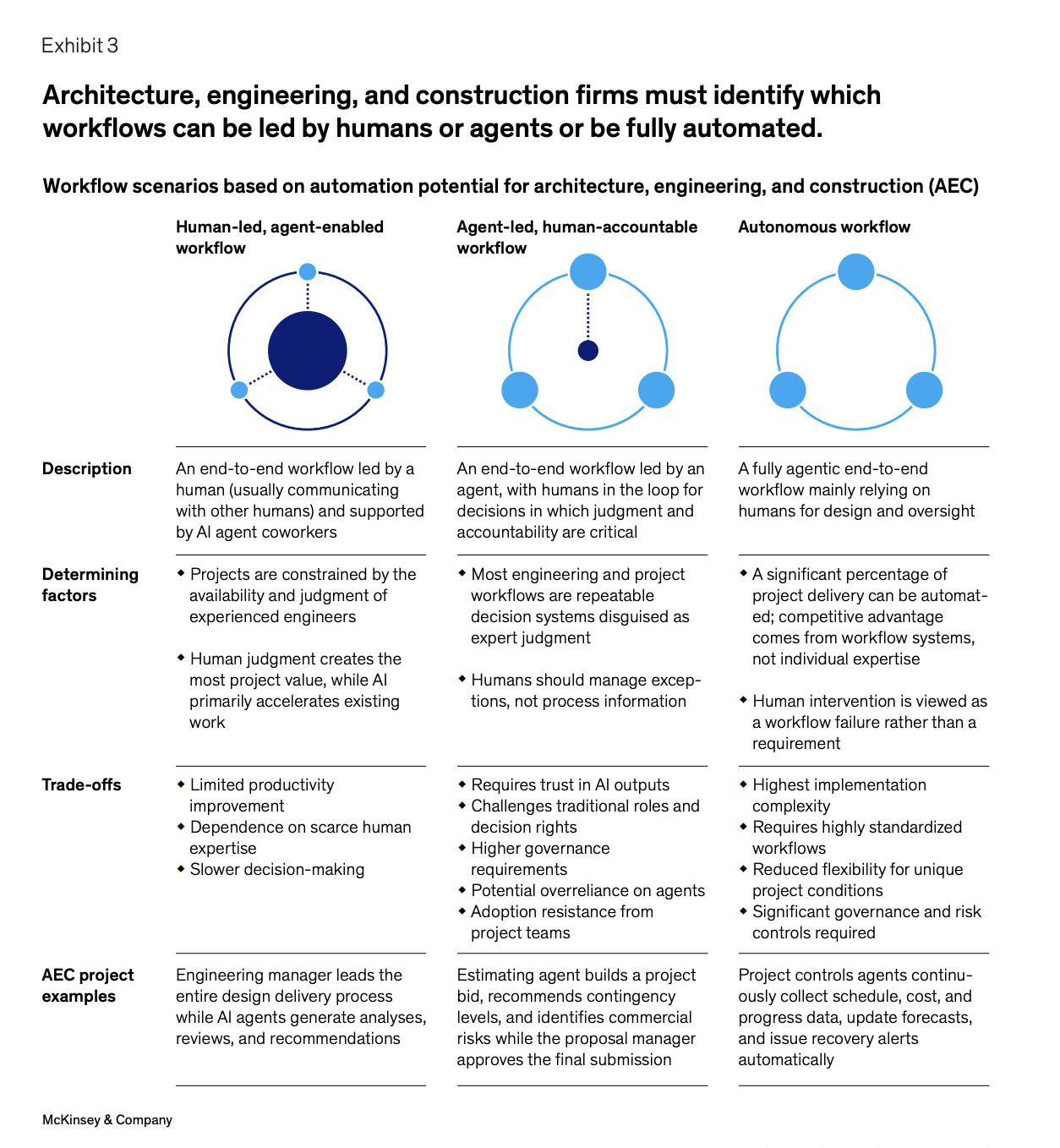
There are more than 150 workflows across 25 domains in architecture, engineering and construction. They won't all change at the same pace: here's what is expected over the coming months.
One rule applies throughout: connect the stages rather than optimise isolated tasks. An estimating tool that never sees the final contract prices learns nothing, something we have fundamentally designed around at Temelion.
French design firms face this shift in a hard market.
The FFB estimated building activity to fall again over the year 2026, a cumulative drop of 12.3% over four years that takes volumes back to late-1990s levels.
At its October 2026 congress, the architects' union Unsfa reported a 19% fall in public design tenders over twelve months, a 10% drop in building permit applications and nearly 400 practices closed. Profitability is eroding too: 67% of practices reported a net profit in 2025, down from 74% in 2023.
Fewer tenders means each one counts more. The firms that win will be those that can respond to more consultations, choose better which ones to pursue, and submit sharper technical proposals, all with the same team.
Yet AI use in French firms remains peripheral. According to the Ordre des architectes' 2025 barometer, about half of practices use AI, but 79% of them mainly to draft text and only 10% for design. In engineering, most teams are still at the appropriation stage, cautious about data protection; Ingérop, for instance, is rolling out AI training across its teams in 2026. The ground is still open.
AI reduces effort, not liability. Clients may automate part of the document work. They won't take on the judgment calls, the escalation of problems or the management of risk. That responsibility stays with the firm that signs the project.
This creates a sharper demand for continued traceability.
Contracts, insurers and clients will want to know how AI was used, on what data, and where a professional reviewed and approved the work. Professional engineering bodies are already updating their codes of conduct to cover the usage of AI. The Ordre des architectes is clear that design cannot be delegated to AI and that the architect remains responsible for the result. An AI that gives an answer without showing its source will not pass this test.
There is a quieter risk too. The tasks AI takes over are often the ones that trained junior staff. Firms will need to train more deliberately, through structured reviews, explicit standards and exposure to real failure cases. Otherwise they risk a generation that knows how to run the tools but not how to judge what comes out of them.
At Temelion, we see the same thing every day. The bottleneck in an engineering firm isn't design. It's the document work around it: go/no-go, technical proposals, bid analysis, estimating. An engineering firm grows at the pace its seniors can tackle the paperwork.
That's why we built a platform covering the whole cycle, from go/no-go to estimating, rather than one more tool. Every finding is sourced, data cleaned, every gap is flagged and every decision stays with the user, the engineer or the architect. Our clients' data stays their proprietary asset. And the bill of quantities from the winning bid feeds the cost base for the next estimate: the more the platform is used, the more reliable the ratios become.
The first wave plays out over the next 18 months. In that time, a few firms will pull ahead with the same headcount. The others will still be deciding.
And you: which process in your firm depends today on just two or three people?
Sources