November 18, 2025

en
.jpg)
At Temelion, we’re betting big on AI. What that also means is that we are at the forefront of data security and compliance. In our world, one cannot exist without the other.
At Temelion, we're automating complex technical documentation and deliverables for building design engineers, and we've learned that the key to unlocking AI's potential isn't just about building better algorithms, but it is about building trust.
Let's explore the current state of AI in construction, why trust is the critical missing piece, and what both AI developers and industry leaders can do to bridge this gap.
Let’s start with what the status quo is, shall we? According to the Royal Institution of Chartered Surveyors survey, approximately 45% of construction professionals reported no AI implementation in their organisations, with 34% still in early pilot phases.
While contractors rate AI highly, actual implementation on job-sites lags significantly behind aspirations.
While there are several challenges to adoption of AI and we’ve discussed some of these here, the biggest obstacle so far can be deemed as cultural. We see that continuously in our discovery calls, questions around data security are the big elephant in the room, despite all the enthusiasm.
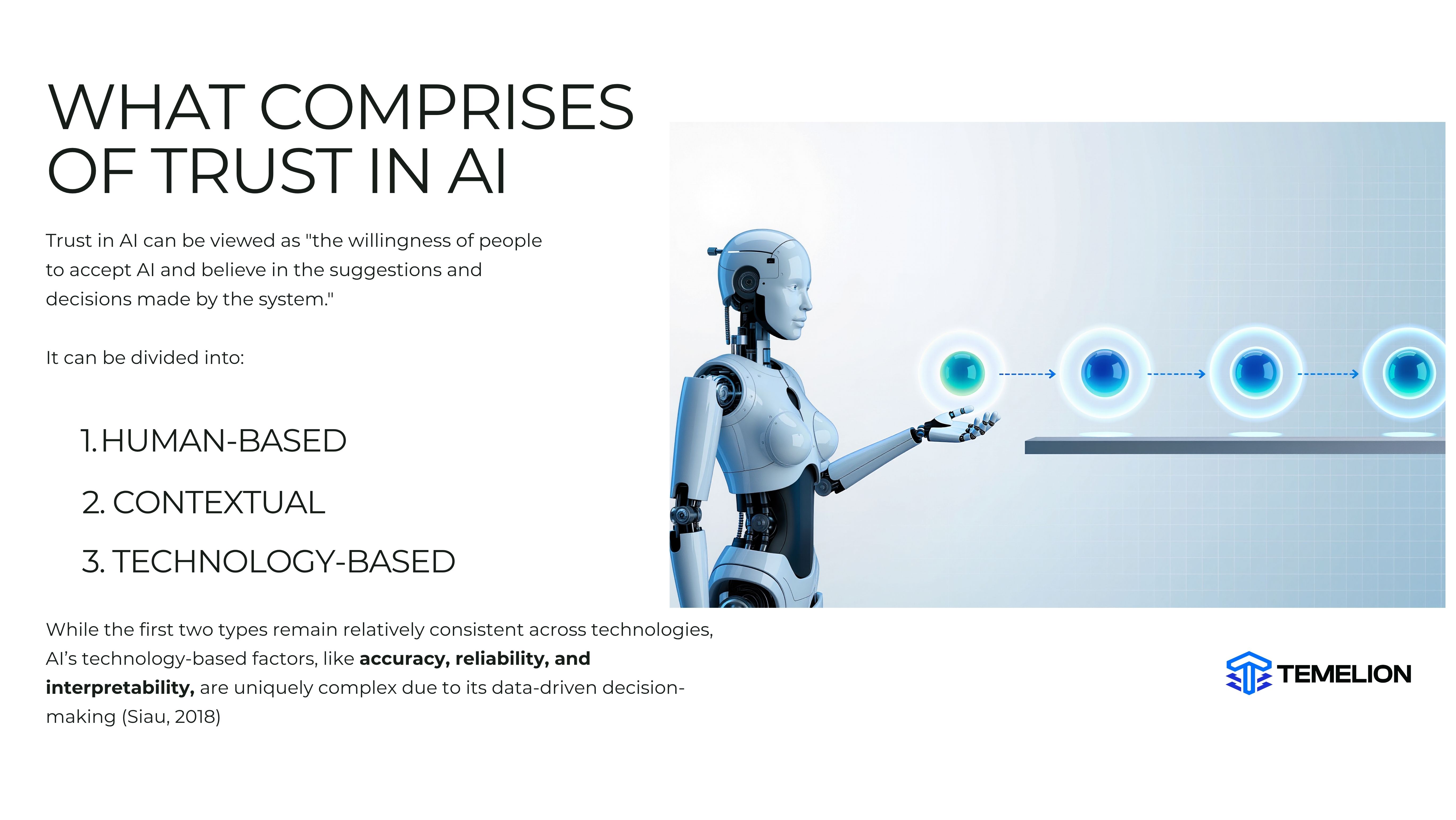
What comprises of trust in AI
According to research, trust in AI can be viewed as "the willingness of people to accept AI and believe in the suggestions and decisions made by the system."
If we are to define what influential factor of trust in technology look like, they can be divided into:
- Human based
- Context based
- Technology based
Overall, influential factors of trust in technology could be divided into human-based, context-based, and technology-based factors. While human and contextual elements influence trust similarly across different technologies, AI presents distinct challenges. Research shows that individuals with naturally trusting dispositions tend to embrace new technologies more readily (Siau, 2018).
Yet AI's trust requirements differ substantially from conventional technologies and even rule-based automation systems. The fundamental distinction lies in AI's capacity to generate novel decisions through learned patterns from training data. This capability elevates the importance of several critical factors: the precision of AI outputs, the consistency of its performance, the visibility into its decision-making process, and the ability to understand why it reaches specific conclusions. These dimensions collectively determine whether user s will view an AI system as trustworthy.
.jpg)
Specific trust barriers that might arise with AI
Beyond construction, if we look across multiple industries, there are some strong barriers to trust that are industry-agnostic. Let’s look at what Building Design Engineering firm might ask in their AI exploration.
1. “How does AI do whatever it does?”
In a McKinsey survey of the state of AI in 2024, 40% of respondents identified explainability as a key risk in adopting generative AI, yet only 17% said they were currently working to mitigate it. Explainability in AI (often called XAI - Explainable AI) refers to the ability to understand and articulate how an AI system arrives at its decisions or predictions.
Think of it this way: when a human expert makes a decision, they can usually explain their reasoning - "I diagnosed this patient with condition X because of symptoms A, B, and C." Explainability in AI aims to provide similar transparency for machine learning models.
Many modern AI systems, particularly deep learning neural networks, operate as "black boxes" - they produce accurate results but the internal decision-making process is opaque.
Explainability can also come in two versions
- Local Explainability: Explains individual predictions
“This project’s safety risk rating was marked as high because the site’s worker fatigue levels and equipment malfunction rate exceeded the model’s safety thresholds.”
- Global Explainability: Describes overall system behaviour
"Our AI model primarily evaluates factors such as worker experience, site conditions, and equipment maintenance history when assessing construction safety risks."
How Temelion supports our clients:
- We work closely with out clients providing clear documentation and transparency on how Temelion’s AI tools generate design suggestions and streamline workflows for engineering teams.
- Adjust the level of explainability to match the client’s use case, so detailed traceability is shown for complex or unique use-cases, while simpler tasks (like repetitive document handling) get streamlined oversight.
2. “I do not want to talk/interact with a machine.”
Research shows that many individuals would rather trust a human prediction than an algorithmic prediction, a phenomenon known as algorithm aversion, because humans are more tolerant if a human is mistaken than if it is an algorithm.
How Temelion supports our clients:
- Involve engineering leads and project managers directly in piloting and testing AI features to ensure practicality and relevance.
- Our subject matter expert works closely with Product and Tech to build Temelion’s AI solutions with built-in human validation steps for all critical project and compliance decisions.
- We are not afraid to tackle head-on AI-anxiety by showing how Temelion’s tools automate repetitive work, helping teams focus on higher-value engineering tasks, while companies should reinforce upskilling and new career opportunities.
3. “Who has my data and is it at risk?”
Data breaches, privacy violations, and intellectual property leakage represent existential risks for many organisations.
In the construction industry, the stakes are especially high: delays due to network or data disruptions can incur large cost overruns, reputational damage and regulatory penalties.
Moreover, construction firms frequently rely on multiple partners, architects, engineers, subcontractors and software providers, meaning ownership and control of data and AI outputs can become unclear.
How Temelion supports our clients:
- We set robust data governance rules for engineering and project data, ensuring traceability and compliance.
- Deploy automated workflows to scan, label, and block sensitive information before sharing with third-party AI tools or platforms.
- Clearly communicate how long Temelion retains project data, how that data is used, and if it is ever used to improve models or service features.
4. “I've been parsing information for a long time - do I need to spend a lot of time using AI?”
A major barrier to AI trust is the persistent “information gap.” Studies show that employees spend up to 3.6 hours daily searching for data across multiple systems (Coveo, 2024; McKinsey, 2024). This inefficiency creates frustration and burnout, weakening confidence in any new technology introduced.
Many organisations fail to provide clear policies on responsible AI use, four in five employees report no such guidance. Past experiences with unreliable systems reinforce the belief that AI will also fail. This creates a self-perpetuating cycle: poor systems cause frustration, leading to distrust, weak adoption, and further validation of doubt.
Actionable steps for Building Engineering Firms:
- Offer interactive, customisable training programs to engineers.
- Create certification programs in partnership with industry associations for engineers who especially need to use the tools regularly.
5. “We do not know how to implement AI.”
Industry leaders suggest that the key to driving AI adoption lies in a strategic, phased approach: identify one problem that can be solved by AI, demonstrate clear value with that single application, and then evangelise the successes to boost broader acceptance.
Actionable steps for Building Engineering Firms:
- Start by deploying AI tools to address clear pain points, such as automating takeoffs, improving safety checks, or speeding up document updates
- Explore our guide to readiness in AI, and implementation, here. If you'd like to explore further, please do connect with our team, here.
Why AI trust matters in construction and to whom
We used Mckinsey’s XAI framework to explore how AI might matter to the various stakeholders. Their needs can be broken down into six personas, each benefitting from different techniques and explanation:
- Directeur de l’ingénierie, Directeur Technique (Executive Decision Makers): Needs model clarity to support key decisions, prove ROI, and ensure project and brand standards are met.
- Chef de projet ingénierie, Chargé de projet ingénierie (Affected Users): Relies on clear explanations of model outcomes to manage projects and daily operations.
- Économiste de la Construction, Assistant Chargé d’affaire (Business Users): Needs sharp, actionable insights from models to improve estimates and workflows.
- Auditors, Regulators (Quality/Compliance Teams): Require model transparency to confirm safe, compliant processes as rules evolve.
- Développeur, IT Digital Tools Team (Developers): Needs model details for debugging and improving digital solutions.
- AI Governance Committee (Legal, Risk, IT, Engineering leads), if there is one: Ensures models meet company policies and regulatory demands, maintaining safety and compliance.
Ready to experience how AI can transform your pre-construction workflows? Explore Temelion and discover how we're helping building design engineers automate technical documentation with precision and compliance.